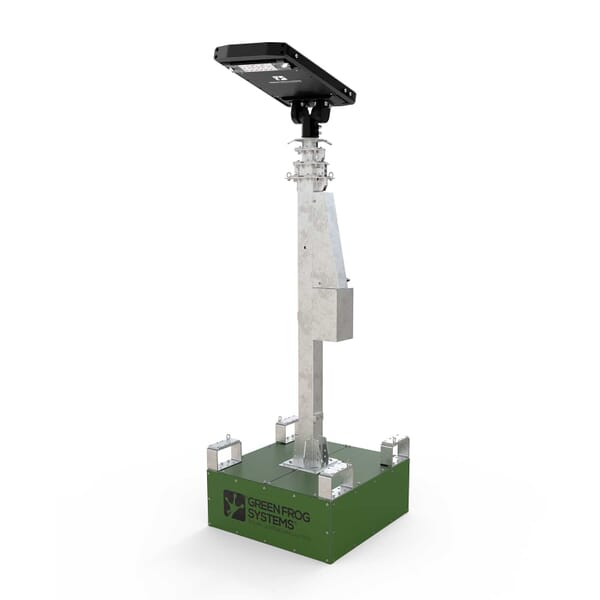


NOMAD 4 — relocatable solar street lighting tower

Relocatable Solar Street Lighting Tower

The Green Frog Systems NOMAD 4 uses a refillable sand-ballast base to bring solar street lighting to changing job sites. Ship the base without ballast, fill it on site and empty it before redeployment. No concrete footing, trenching or grid connection.

Choose a single- or dual-arm configuration with road-optics LED lighting at a 37.7 ft mounting height, a 1 kW rotating solar array and a 10 kWh LiFePO4 battery.

data sheetDownload NOMAD 4 Single LED PDF

data sheetDownload NOMAD 4 Twin LED PDF

Description

NOMAD 4 — relocatable solar street lighting tower

The Green Frog Systems NOMAD 4 solar street lighting tower is built around a refillable steel base. Transport the base without sand ballast, fill it at the job site and empty it when the project moves. The empty base weighs 1,208 lb, allowing ballast to be sourced and left on site instead of transported between locations.

NOMAD 4 provides road-optics LED lighting at a 37.7 ft mounting height for road construction, mining and infrastructure projects. It installs without a concrete footing, trenching or grid connection.

Single- and dual-arm configurations

NOMAD 4-1000-A — single arm

One 150 W road-optics LED luminaire on a 13.1 ft curved outreach arm. Drive power can reach up to 200 W, depending on location. Choose 3000K or 4000K CCT.

NOMAD 4-1000-B — dual arm

Two 150 W road-optics LED luminaires provide 300 W total, with drive power dependent on location. Two 9.8 ft curved outreach arms provide a 19.7 ft tip-to-tip span. Choose 3000K or 4000K CCT.

Both models use a fixed, non-telescopic hot-dip galvanized column and have an overall height of 38.2 ft.

Use your DOT-approved luminaire

Luminaires are specified generically, so a state DOT or agency can fit its own approved, DOT-listed LED fixture with the optics and lenses it requires. The standard luminaire is 150 W, and the driver supports up to 200 W per luminaire, set by the site lighting design and solar resource.

Solar power without trenching

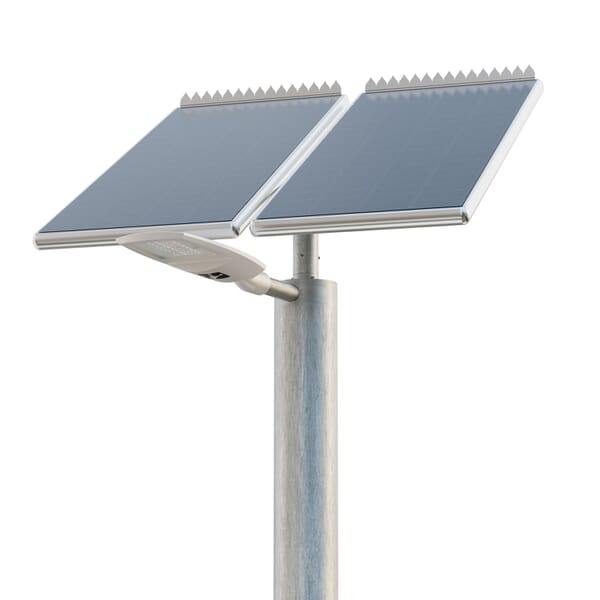
Two Aspire 500 W panels provide 1 kW of solar capacity on a rotating T-piece mount. The base can be placed to suit the site, then the array is turned south. A 10 kWh LiFePO4 battery and control equipment are housed inside the vandal-resistant base.

The KX1000 smart controller offers fixed LED output or automatic power scaling. An optional second 10 kWh battery supports cameras, environmental sensors, communications, telemetry and other site equipment.

Remote monitoring

Satellite remote monitoring and control provides access to fleet status, battery state and lighting schedules without relying on cellular coverage. Satellite connectivity is optional on NOMAD 4-1000-A and listed on NOMAD 4-1000-B.

Relocate as the work changes

Integrated forklift pockets support base handling. Place the base with a forklift, fill it following the supplied ballast instructions and rotate the array south. Erecting the column to its 37.7 ft mounting height requires a crane or lifting device at each installation. When the project stage changes, empty the ballast, lower the column with a crane or lifting device and relocate the tower to the next work zone or project.

The reusable base eliminates the need to install and abandon a concrete footing each time the lighting location changes.

Lighting design and site engineering

NOMAD 4 is designed for roadway lighting to ANSI/IES RP-8. For highway work zones, layouts follow state DOT nighttime work specifications and NCHRP Report 498 illumination guidelines. Compliance is confirmed by a site-specific photometric design supplied with each proposal.

Wind suitability assessed per job site; engineered ballast schedule and certification documentation supplied with each proposal.

Applications

  • Road construction work zones and detours
  • Staged roadway traffic shifts and intersections
  • Equipment staging areas and construction compounds
  • Mine haul roads and internal access roads
  • Mining camps, parking lots and walkways
  • Ports, rail corridors and utilities
  • Events and temporary public spaces

Contact Green Frog Systems for pricing and specification — Tell us the site and the job, and we’ll help you select a single- or dual-arm NOMAD 4 configuration.

Key Features

Refillable sand-ballast base. Ship the base without ballast, fill on site and empty before relocation. The lighting tower moves with the project while the ballast stays behind.

1,208 lb empty base. Integrated forklift pockets support handling without transporting the filled ballast load between sites.

No concrete footing or trenching. Install solar street lighting without a grid connection or permanent footing.

37.7 ft mounting height. Road-optics LED luminaires on a fixed, non-telescopic hot-dip galvanized column.

Single-arm model. NOMAD 4-1000-A has one 150 W luminaire on a 13.1 ft arm, with drive power up to 200 W depending on location.

Dual-arm model. NOMAD 4-1000-B has two 150 W luminaires, 300 W total, on two 9.8 ft arms with a 19.7 ft tip-to-tip span. Drive power is location dependent.

1 kW rotating array. Two Aspire 500 W panels on a rotating T-piece mount allow the array to face south after placement.

10 kWh battery storage. LiFePO4 battery and control equipment are housed inside the vandal-resistant base.

Optional auxiliary storage. A second 10 kWh battery supports cameras, sensors, communications, telemetry and other site devices.

KX1000 controller. Select fixed LED output or automatic power scaling.

Satellite connectivity. Remote monitoring and control without cellular coverage. Optional on NOMAD 4-1000-A; listed on NOMAD 4-1000-B.

No fuel or engine noise. Solar operation without refueling visits.

10-year structural warranty. Hot-dip galvanized construction, covered under GFS terms and conditions.

Technical data

ModelNOMAD 4
ConfigurationsNOMAD 4-1000-A — single arm / NOMAD 4-1000-B — dual arm
LED Specifications
Luminaire TypeRoad-optics LED
Single-Arm Lighting4-1000-A: 1 × 150 W luminaire; drives up to 200 W, location dependent
Dual-Arm Lighting4-1000-B: 2 × 150 W luminaires, 300 W total; drive power location dependent
CCT3000K / 4000K
Luminaire Mounting Height37.7 ft
Solar & Control
Solar Array1,000 W — 2 × Aspire 500 W panels
Array MountingRotating T-piece mount
Array OrientationTurned south after placement
ControllerKX1000 smart controller
Operating ModesSelectable automatic power scaling or fixed LED output
Battery & Auxiliary Power
Battery TypeLiFePO4
Standard Battery Capacity1 × 10 kWh, integrated in the base
Optional Battery Capacity2 × 10 kWh
Auxiliary ApplicationsOptional second battery supports cameras, environmental sensors, communications, telemetry and other site devices
Equipment HousingBatteries and control equipment inside the vandal-resistant base
Structure & Dimensions
StructureFixed, non-telescopic hot-dip galvanized column
Overall Height38.2 ft
Single-Arm Outreach4-1000-A: 13.1 ft curved arm
Dual-Arm Outreach4-1000-B: 2 × 9.8 ft curved arms; 19.7 ft tip-to-tip
Base Dimensions59.1 × 59.1 × 43.5 in — length × width × height
Empty Base Weight1,208 lb, excluding ballast
Base HandlingIntegrated forklift pockets
Ballast & Deployment
Base TypeRefillable sand-ballast steel base
BallastSite-sourced ballast, filled on site following the supplied ballast instructions
PlacementForklift / crane placement
Array SetupRotate array south after placement
Site InstallationNo concrete footing, trenching or grid connection
RedeploymentEmpty ballast before relocating to the next position or project
Connectivity
4-1000-AOptional satellite remote monitoring and control
4-1000-BSatellite remote monitoring and control
Remote FunctionsFleet status, battery state and lighting schedules
Network RequirementSatellite connectivity does not depend on cellular coverage
Operation & Warranty
OperationSolar powered; no fuel or engine noise
Structural Warranty10 years, per GFS terms and conditions

Solar performance figures are engineering estimates from long-term climatological averages and are not a guarantee of energy yield. Specifications are subject to change without notice.

FAQ

Which NOMAD do I need?

Pick by the job. NOMAD 1 is general lighting for walkways, workforce camps and site access. NOMAD 2 is large-area lighting for laydown yards, parking lots, storage yards, security and disaster response. NOMAD 4 is temporary roadway lighting for highway work zones and dangerous intersections. Not sure? Send us your site and we’ll recommend one, with a free site performance report.

Is NOMAD 4 suitable for roadway lighting?

Yes. NOMAD 4 is designed for roadway lighting to ANSI/IES RP-8, with high-output road-optic LED luminaires at 37.7 ft and drive power set to the lighting design for your site. For highway work zones it is specified to the state DOT night-work lighting requirements. Lighting designs and site performance reports are supplied with proposals.

What is the difference between the two configurations?

NOMAD 4-1000-A has one luminaire on a 13.1 ft arm, 150 W as standard. NOMAD 4-1000-B has two luminaires, 2 x 150 W (300 W total), on two 9.8 ft arms with a 19.7 ft tip-to-tip span. Both mount the luminaires at 37.7 ft. The driver supports up to 200 W per luminaire, so in high-irradiance locations such as the desert Southwest the drive power can be raised where the site’s solar resource supports it.

Can we use our own DOT-approved luminaire?

Yes. NOMAD 4 is designed around a generic high-output road-optic LED luminaire, so it can be supplied with a locally approved, DOT-listed fixture that meets your agency’s optics and lens requirements. The driver supports up to 200 W per luminaire, and GFS sets the drive power to your lighting design and the site’s worst-month solar resource.

Does NOMAD 4 need a crane?

The base is placed by forklift, but erecting the fixed 37.7 ft column requires a crane or lifting device at each installation. Routine servicing is done without trenching or utility work.

How is NOMAD 4 rated for wind?

Wind suitability is assessed for each job site. Every unit ships with an engineered ballast schedule, and certification documentation is supplied with the proposal. Custom configurations are available for hurricane-prone regions.

How long does NOMAD 4 run without sun?

At the reference site, NOMAD 4-1000-A has approximately 4.4 nights of zero-sun reserve. NOMAD 4-1000-B reserve is engineered per site. Autonomy and recharge times are engineered per site with worst-month solar verification, and will vary by location and season.

How do you move NOMAD 4 between work zones?

Empty the ballast and leave it on site as clean fill, lower the column with a crane or lifting device, and fork the base out. No concrete footing is left behind.

Can I monitor a fleet without cellular coverage?

Yes. Satellite connectivity provides remote monitoring, control and scheduling without relying on cellular networks.

Can NOMAD 4 power other site equipment?

An optional second 10 kWh battery supports cameras, environmental sensors, communications and telemetry from the same tower.

How do I order NOMAD 4?

Contact Green Frog Systems for pricing and specification. Tell us the site and the job, and we’ll recommend the configuration, program mode and ballast schedule for your location.